A parent’s guide to autism spectrum disorder, Applied Behavior Analysis (ABA) therapy, and the early intervention programs available at ABC Center Singapore.
Autism Spectrum Disorder (ASD), commonly called Autism, is a neurodevelopmental condition that affects how a person communicates, interacts with others, learns and experiences the world. It is called a “spectrum” because it looks different in every child: some need substantial support in daily life, while others are highly independent. There is no single cause or cure.
Evidence-based intervention — most commonly Applied Behavior Analysis (ABA) therapy, especially if started early — can help a child build meaningful communication, social, learning and daily living skills.
Autism Spectrum Disorder (ASD), commonly called Autism, is a neurodevelopmental condition that affects how a person communicates, interacts with others, learns and experiences the world. Autism begins early in development, although the signs may become more noticeable as a child grows and social and communication demands increase.
Autism is called a “spectrum” because it can look very different from one person to another. Some children may have little or no spoken language, while others may speak fluently but have difficulty with conversation, social cues or relationships. Some may require substantial support in everyday life, while others become highly independent.
Not every child with autism will have the same characteristics or challenges.
Autism is not defined only by difficulties. Children with autism have their own strengths, personalities, interests and abilities. Intervention should not aim simply to make a child appear “less autistic.”
The goal is to help each child develop meaningful communication, learning, social and daily living skills, while reducing behaviors that may interfere with learning, safety or independence.
Early identification and intervention are important. The developing brain has significant capacity for learning, particularly during the early years, and evidence-based intervention can help children build skills that can make a meaningful difference to their development and quality of life.
One of the most evidence-based interventions is Applied Behavior Analysis (ABA) therapy. This is recognized by the American Academy of Pediatrics as well as the American Psychological Association and has more than 50 years of clinical evidence. If ABA therapy is planned and implemented well under the supervision of a Board-Certified Behavior Analyst, it can make a significant difference to each child.
ABA starts by looking at each individual child to determine what skills the child needs, what makes learning difficult, or why particular behaviors occur. It is then used to develop a wide range of skills including language and communication, social and play skills, learning and school readiness, self-help and independence, as well as reduction of tantrums and challenging behavior.
years of research behind Applied Behavior Analysis (ABA) as an autism intervention
years of experience across ABC’s global network supporting individuals with autism and developmental disabilities
Applied Behavior Analysis (ABA) is one of the most extensively studied approaches used to help individuals with autism learn and develop. ABA autism therapy has been researched for more than 50 years, and its principles form the foundation of many evidence-based autism interventions.
What skills does the child already have? What’s making learning difficult, and what would help most?
Complex skills are broken into achievable steps, taught systematically using reinforcement and the child’s own motivation.
Progress is measured through data, so the program is continually adjusted to how the child responds.
ABA is based on the science of how people learn. Rather than applying the same program to every child, an ABA programme looks at the individual child: What skills does the child already have? What is making learning difficult? Why is a particular behavior occurring? What skills would make the biggest difference to the child’s everyday life?
Complex skills are then broken into achievable steps and taught systematically, using reinforcement and the child’s own motivation to encourage learning. Progress is measured through data, allowing the programme to be continually adjusted according to how the individual child responds.
Requesting what they want, answering questions, having conversations and communicating thoughts and needs
Interacting with other children, taking turns, understanding social cues and participating in group activities
Attention, following instructions, imitation, early literacy and numeracy, and classroom behaviour
Dressing, eating, toileting and other everyday skills
Understanding why challenging behaviour occurs and teaching more appropriate ways to communicate, cope and respond
Helping the child use skills not only during therapy, but also at home, at school and in the community
APA
The American Psychological Association states that the practice and supervision of ABA are well-grounded in psychological science and evidence-based practice.
AAP
The American Academy of Pediatrics describes ABA as an important approach used in evidence-based autism intervention, and notes that most evidence-based treatment models incorporate principles of ABA.
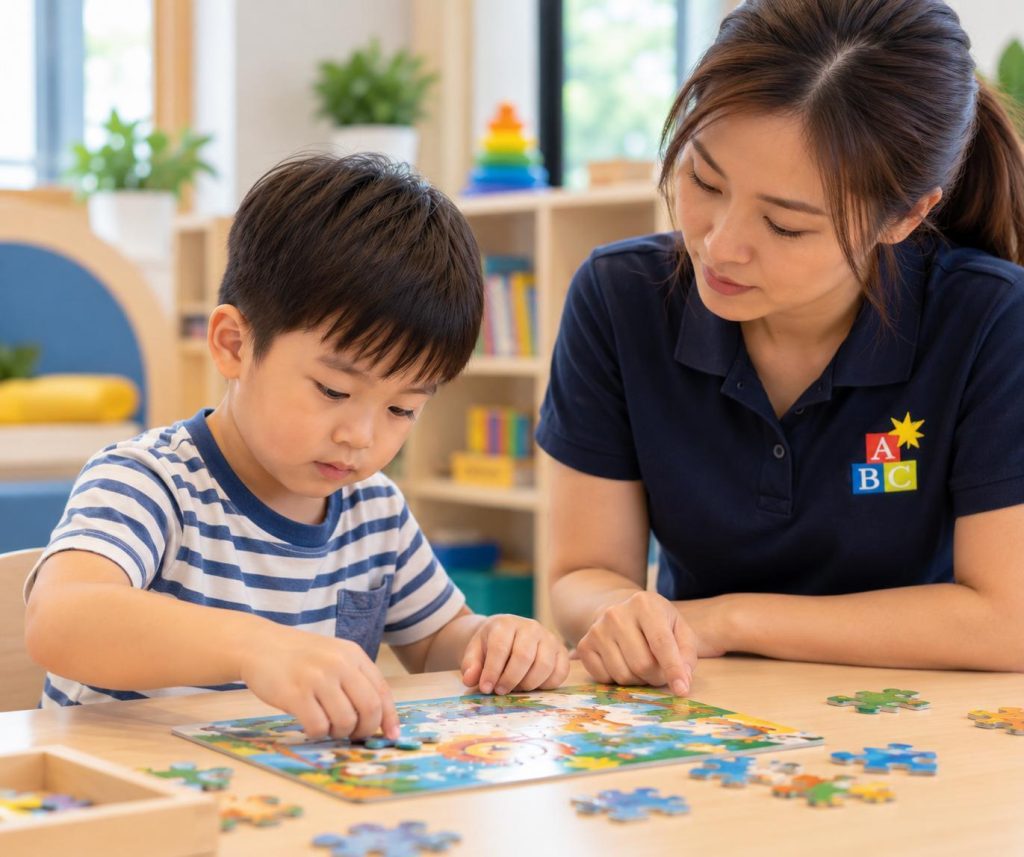
Importantly, well-designed and well-implemented ABA can look very different from the highly structured therapy people sometimes associate with the term. Under the guidance of an experienced Board-Certified Behavior Analyst (BCBA), ABA can take place during play, daily routines, social interaction, classroom activities and real-life experiences.
What remains constant is the scientific approach: identifying meaningful goals, teaching systematically, measuring progress and adapting the intervention based on the child’s response. Read more about what ABA intervention involves.
At ABC Center Singapore, we provide individualized, evidence-based ABA intervention for children with autism and other developmental needs. If you are looking for autism therapy in Singapore, ABC Center is part of the global network of USA-based Applied Behavior Consultants, with more than 30 years of experience helping individuals with autism and developmental disabilities.
As an applied behavior center for autism and an established autism centre in Singapore, our expertise lies in well-designed and well-implemented ABA intervention with the aim of unlocking the potential of each child in our care.
Our services span from infants and toddlers through school-age children and older children developing greater independence, allowing the type and intensity of support to change as a child develops.
Ages 0-3. Play-based ABA intervention for children showing early signs of autism or developmental differences. No formal diagnosis required to begin.
Ages 3–12. Individualized intervention across communication, cognition, social/play skills, school readiness, independence and behaviour. Eligible for EIPIC-P subsidies.
Combines each child’s individualized education program with classroom behaviour, communication and social skills, preparing children for mainstream or special education.
Therapy delivered in the child’s home environment, with greater family involvement in every session.
For higher-functioning children developing social skills — understanding social cues, appropriate behaviour and response.
Ages 9+. Self-help, home tasks and pre-vocational job readiness for older children and young adults.
School-based support, including shadow teaching and behavioural program design alongside your child’s school.
ABA training for autism caregivers, teaching families the strategies used in session to ensure consistency between centre and home.
Programs designed for families based in Malaysia and Indonesia seeking ABA intervention in Singapore.
Beyond ABA therapy, we also offer integrated Speech Therapy, Occupational Therapy and Educational Psychology consultation, if needed by the child. We also provide Before- and After-Hours care, offering recreational activities while allowing for more convenient pick-up and drop-off timings for parents.
Intervention can be provided at our centres or, where appropriate and subject to availability, in the child’s home. Programs are designed and supervised by Board-Certified Behavior Analysts (BCBAs) and individualized according to each child’s strengths, needs and rate of progress. Learn more about our approach or explore the full range of our programs.
Every child at ABC Center is guided by an Individualized Education Program (IEP), a plan built around that specific child’s strengths, needs and pace of progress, not a fixed curriculum applied to every child.
A BCBA designs each child’s IEP after assessment, sets measurable goals across the skill areas that matter most for that child, and reviews it continually against session data, adjusting the approach whenever the data shows a change is needed. This individualized-planning approach runs through every ABC programme, from one-to-one ABA Intensive Early Intervention to the small-group learning goals inside EarlyPreps.
Whether your child is a toddler showing early developmental concerns, a young child recently diagnosed with autism, or an older child who needs help with communication, social skills or independence, ABC’s goal remains the same: To help each child build the skills they need to participate more fully in family, school and community life, and reach their individual potential.
ABC Center offers one of Singapore’s most established early intervention programs for autism, spanning our Infant/Toddler Program for children under 3 through our ABA Intensive Early Intervention Program for ages 3 to 12.
Early intervention programs for autism work because the evidence is consistent: starting as soon as a child shows signs of autism or developmental delay — not after a formal diagnosis — gives the developing brain the widest possible window to build new skills. Waiting for paperwork should never mean waiting on a child’s development.
For Singapore Citizen and Permanent Resident children aged 2 to 6, ABA-based early intervention is available through the government-subsidized EIPIC-P programme (Early Intervention Program for Infants & Children), administered by the Early Childhood Development Agency (ECDA), with subsidy levels dependent on means-tested household income. ABC Center Singapore has been an appointed EIPIC-P provider since the program’s inception in 2018.
Every ABC Center early intervention program for autism follows the same evidence-based sequence, individualized to your child from the very first conversation:
ABC Center Singapore operates from two locations for families across the island: Somerset/Dhoby Ghaut (Central) and Mountbatten (East). Both centres are staffed by BCBA-supervised teams delivering the same individualized, evidence-based ABA intervention described on this page.
ABC Center has over 30 years of experience helping children worldwide via ABA therapy.
Please see our services here.
ABA is a scientific, evidence-based approach to understanding and changing behavior, often referred to as autism ABA therapy. For autism, an ABA programme assesses an individual child’s skills and needs, breaks target skills into achievable steps, and uses reinforcement and data to teach communication, social, learning and daily living skills while reducing behaviors that interfere with learning or safety.
No. A formal diagnosis is not required to begin therapy. Children who show signs of developmental delay, or are at-risk of autism are recommended to seek ABA therapy as soon as possible to begin addressing learning issues early, even without waiting for a formal diagnosis.
As early as possible. ABC Center’s Infant/Toddler Program supports children from as young as 12 months, and evidence consistently shows that the developing brain has the greatest capacity for learning new skills in the early years.
Look for a centre where programmes are designed and supervised by a Board-Certified Behavior Analyst (BCBA) — the recognized credential for ABA practice — and where intervention is individualized to your child rather than delivered as a fixed curriculum. ABC Center’s programmes are BCBA-supervised and are part of a global network with more than 30 years of experience in autism and developmental disability intervention.
ABC Center Singapore operates from two locations: Somerset/Dhoby Ghaut in Central Singapore and Mountbatten in the East. Both offer the same individualized, BCBA-supervised ABA intervention, and we also offer an In-Home ABA Program for families who need therapy delivered at home.
An IEP is the specific set of goals and teaching plan designed for one child, based on their own assessment results, strengths and needs, rather than a standard curriculum used for every child. At ABC Center, a BCBA builds and continually adjusts each child’s IEP based on session data.
Yes. Our Parent/Caregiver Training programme is a structured form of ABA training for autism — teaching families the same strategies used in session, so the approach stays consistent between the centre and home, which is one of the strongest predictors of a child’s progress.
Yes. ABC Center Singapore has been an appointed EIPIC-P provider since the program’s inception in 2018, offering government-subsidized ABA intensive early intervention for eligible Singapore Citizen and Permanent Resident children aged 2 to 6.
Schedule a free, no-obligation consultation with our BCBA-supervised team to discuss what evidence-based autism intervention could look like for your child.
This content is intended for general informational purposes and does not replace individualized clinical or medical advice. For a personalized recommendation, please consult our team directly.
EIPIC-P is a programme administered by the Singapore government’s Early Childhood Development Agency (ECDA) that enables Singaporean or Permanent Resident children who meet criteria to avail of financial subsidies for early intervention.
The children must be between 2 – 6 years old, and recommended by a professional (e.g. recognized paediatrician) for early intervention. The financial subsidy for Singaporean children is dependent on means-tested household income.
ABC Center is honored to have been appointed as an EIPIC-P provider since the programme’s inception in 2018 (previously known as PPIP programme). If you have questions on how to avail of the programme, please contact us and we can guide you through the process.